
#90: What else could this become?
Building things from existing things

Hey!
This week I am witnessing how things become other things. This article is one such reflection. The other is seeing Mark Johnson and Life of Linh, my writing buddies, start a paid writing cohort inspired by what we gained from getting feedback on our writing every week :) Registration closes this Thursday. I can vouch that you will love being part of this writing cohort.
My calendar is still open for no-agenda one-to-one conversations if you’d like to connect. You can schedule one here.
Another happy moment from the last week :)
Last month I attended a parenting workshop. I’m not a parent, but I do have a nephew whose replies sometimes make me wonder a lot of things about myself. I was also curious about how a classic children’s book could become the basis for a parenting workshop1.
The Little Prince is a magical novella written by French writer and military pilot Antoine de Saint-Exupéry in 1943. The book begins with a drawing. As a boy, the narrator draws a snake that has swallowed an elephant. Every adult he shows it to sees a hat. He explains what it really is. They tell him to set the drawing aside and study something useful, so he stops.
Though it has been categorised as a children’s book, I feel it says a lot about how we as grown-ups lose our ability to see things beyond what they literally look like to us. Somewhere we lose our imagination as the world starts rewarding us for the one correct answer. As children, we learn to see possibilities. As adults, we learn to recognise categories (correct or incorrect). In between all of this, we may become very good at seeing what we already know, and worse at seeing what else could be there.
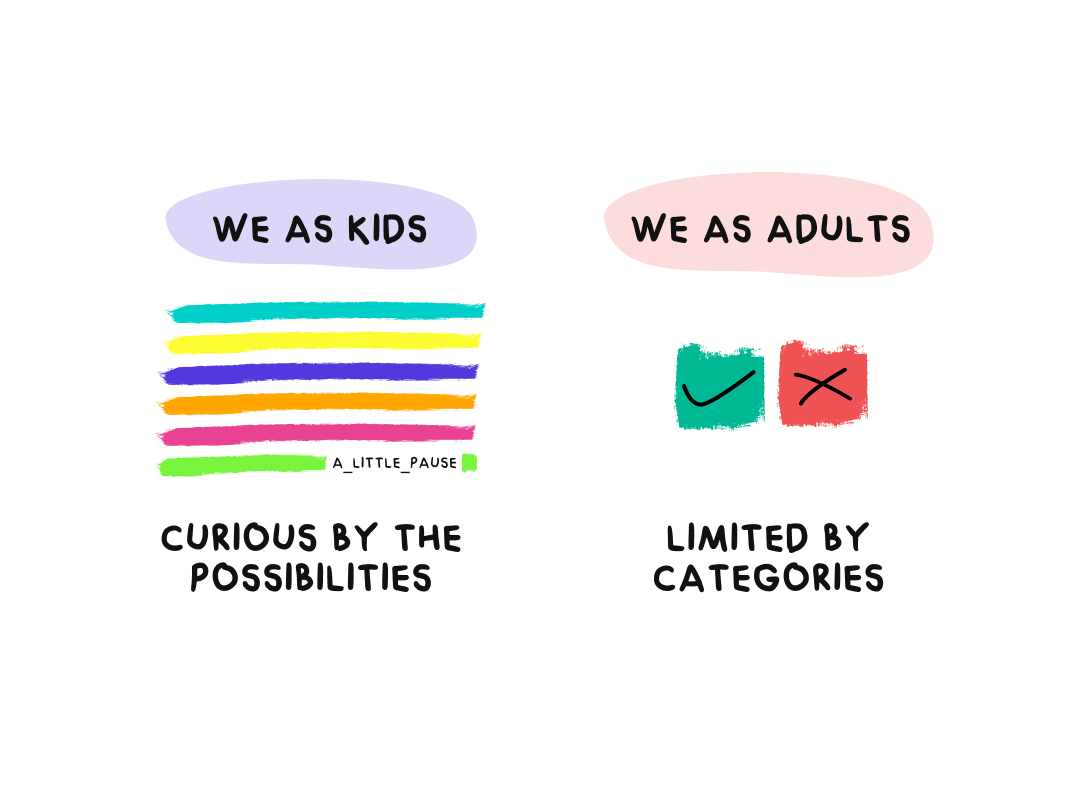
This book is so full of beautiful symbolism, metaphors and creative imagination for the mundane things in life. I feel one will discover a new meaning every time they read it.
Preeti, the facilitator for this workshop, started it with a prompt asking what we were curious about as children. What came out of this question were so many mundane yet beautiful things — clouds, finding shapes in random objects, rainbows, and more. But none of us really feel excited when we see them now. Moreover, we have pretty much stopped noticing them altogether. It made us reflect on how rarely we adults engage in the world with childlike wonder.
The boy (little prince) in the story sees the world as it is, before anyone has taught him to look away. We all started this way as kids. And it invites us to reflect: how can we, as parents, learn to see the world the way our child still sees it, instead of asking the child to see it the way we do? I remember someone sharing how their little kid shows her excitement every time she sees the moon. And how, as a mother, she has borrowed that excitement from her kid and started noticing the moon again.
The facilitator then took us to the six planets the little prince visited in the book, where we met six single-minded characters. When I read it for the first time, I could not see our hidden parenting styles in each of these characters. Preeti laid that down for us. And with each character corresponding to a parenting style, each of us could witness which one we relate to or mostly act like. For example, the businessman character who constantly spends time on counting, cataloguing, and claiming ownership over the stars mirrors the behavioural patterns of an authoritarian or highly transaction-driven parenting style.
What helped us get deeper is the reflection prompt that asked us to explore the scripts we parent from: how do we show up when we are in that character, and does the way we show up for our children relate to how our parents showed up for us?
The picture actually got much clearer when we discussed it with a small group of strangers. It allowed us to dive into our own patterns and reveal what’s hidden for us. I have noticed that speaking out loud helps me understand what I am thinking even when I know what it is. My thoughts get clarified in speech, and for some reason it happens more easily with strangers, especially when I am talking about vulnerabilities, fears or things I may be feeling guilty about. And when people respond by saying, Oh! that’s so me, I get some confirmation that I am not alone in what I feel and do sometimes.
I went into the workshop thinking I would learn something about parenting from a children’s book. I left thinking about something totally new: how much of creation is really recombination.
The facilitator took a children’s book, connected it with Transactional Analysis2, turned it into reflection prompts, and created conversations between strangers that left each of us with something to think about. This workshop was a perfect demonstration of how we can create things out of things. It also made me wonder how our prior knowledge allows us to make these connections and simplify theoretical concepts in a much more practical way. Finding a meaning that isn’t so apparent and helping people see it is a superpower of facilitation.
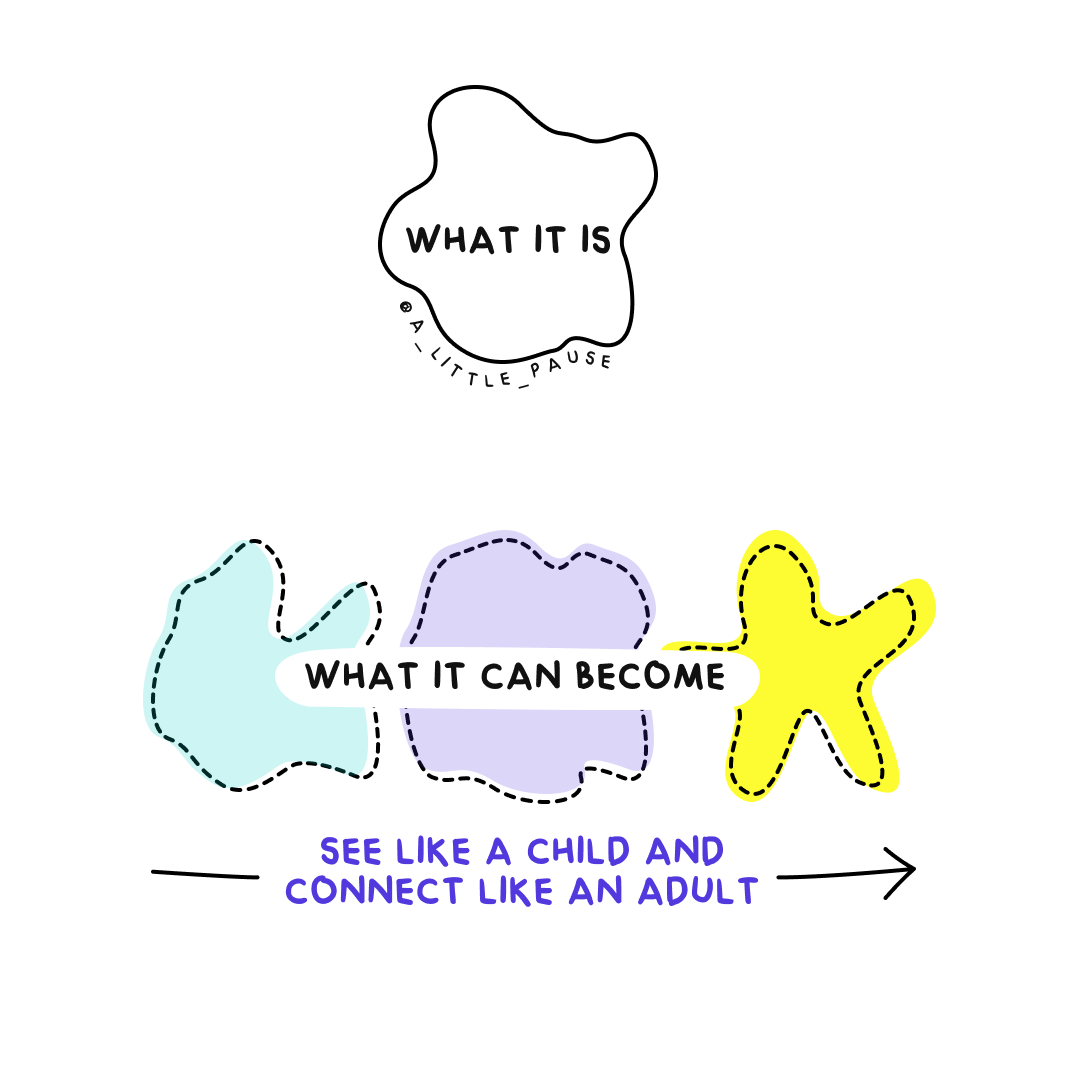
I realise that growing up isn’t only about losing our childlike way of seeing. It’s also about gaining the ability to combine experiences, knowledge and frameworks into new ways of seeing. A workshop based on a children’s book showed me both what we lose and what we gain as we grow up. And perhaps the best creators and facilitators are people who can do both: see like a child and connect like an adult.
Creativity isn’t always about creating things from scratch. Most of the time, it’s about looking at things that already exist in the form of a book, experience, feelings, conversation and seeing a connection that wasn’t obvious before. Creation needs noticing what is already there and asking, “What else could this become?”
I am slowly witnessing the metamorphosis of a book into a workshop, of a workshop into reflection, and of reflection into this article.
And not forgetting to implement what I learn from the parenting workshop by trying to see my nephew’s world through his lens :)
Related Posts:


Take a Little Pause 🌼
I consider this section of the newsletter a prompt that invites you into your own process of discovery.
Have you witnessed the beauty of how things become other things? What can you create next from what you already know?
If you feel like sharing, I am all ears.

Sketch what you read
Join me in the next cohort of Book to Visuals, a 4-week practice lab where I share my step-by-step process to transform what you read/think into simple hand-drawn visuals. No drawing experience or digital tool needed. Next cohort starts in October. Avail the early bird offer by Sept 15.
A practical, fast-paced course to go from ‘I can’t draw’ to a visual thinker in 4 weeks.
— Jeevan, Product Designer, BTV - April 2026
Ways to support my creative journey 🎨✨
Register for Book to Visuals - Turn the ideas you read/think into simple, memorable visuals. Join the last cohort of 2026 in Oct.
License my illustrations – Love any of my illustrations? Use them for your brand.
Hire me to illustrate for your brand, concept or upcoming book.

Take a Little Pause is an illustrated weekly newsletter for anyone navigating the beautiful messiness of building a creative, calm and intentional life. If you’re on a similar journey, subscribe for free or become a paid supporter to support my writing.💛
The workshop was facilitated by Preeti Balasaria, a Transactional Analyst (TA) practitioner. Here is the LinkedIn post about the workshop.
TA is a fascinating model for understanding human behaviour, communication and relationships. TA 101 is an introductory 2-day course to the key ideas in Transactional Analysis (a psychoanalytic theory by Eric Berne). I did this certification a few months back from School of You.
I totally agree, Rachna. Creativity is all about connecting things. It's been my learning from Steal Like an Artist, too.
This title. So good.
What else could this become? So many possibilities of things that evolve. I was looking forward to the illustrations in this story and am loving what you have done here.